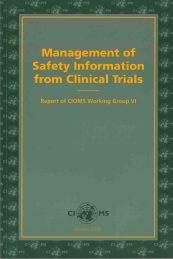

Management of Safety
Information from Clinical Trials
Report of CIOMS Working Group VI
VISION
Patients and prescribers expect
approved medicines to be "safe and effective." The goal of
those who produce and regulate proprietary medicinal
products is to ensure that this expectation is met. This
requires that clinical trials be planned and performed to
provide good evidence that tested medicines are effective
and that patients can be reassured that the benefits
outweigh the risks, both during the development process and
in general use.
This report has implications for all stakeholders in
clinical medicinal research;
1)
patients and other volunteers
investigators
and their site staff
ethics
review committees
data
and safety monitoring boards
drug
regulatory authorities and the public health community
pharmaceutical
companies and other clinical research sponsors
The vision of the CIOMS VI Working Group is that this report
will enhance awareness of the ethical and technical issues
associated with safety in clinical trials and point out the
need for increased care and scrutiny in the conduct of
research. It is also hoped that this work will advance the
methodology for collecting, analysing, evaluating and
reporting information on product safety ascertained in
clinical trials, and help to set standards in these areas.
Establishing and maintaining standards by all involved
groups will benefit all participants in trials and improve
public health for those who take medicines.
Pharmacovigilance has traditionally focused on detection and
evaluation of signals in the post-approval environment in
order to secure early detection of new adverse reactions or
patient subgroups of exceptional sensitivity, and to
introduce measures to manage those risks.
However, we believe that there is a need not only to
incorporate newer approaches for managing safety information
in the clinical trial setting, but also to adapt the methods
and tools used in post-approval pharmacovigilance to the
early and late stages of pre-approval development of
medicinal products. It is our vision that the practical
approaches provided in this report will aid these processes
and will enable a more seamless transition in conducting
high quality pharmacovigilance from the development stage to
the post-approval period. We also hope that this work will
stimulate research in several unresolved areas.
Finally, we recognize that new regulations have recently
been enacted in the EU and are pending elsewhere, such as in
the US. It is hoped that this book will stimulate the
regulators to reconsider aspects of regulations pertaining
to our proposals; we believe that our suggestions can help
to improve the ability to generate and analyze useful safety
data and to protect trial participants.
TABLE OF CONTENTS
VISION
PREFACE
1. INTRODUCTION AND OVERVIEW
a. Rationale for
the CIOMS VI Project
Results of the CIOMS VI Survey on Company
Practices
Areas Covered by the CIOMS
Project
- Terminology and
definitions
- Ethical aspects of clinical
trials
- Overall pharmacovigilance/risk
management system
- Collection and proper management
of safety data
- Evaluation of safety
data
- Statistical analysis of safety
data
- Regulatory reporting and
communication to others of safety information
- during clinical trials
d. Limitations of Clinical Trials for
Understanding Safety
Scope of the Project
2. ETHICAL CONSIDERATIONS FOR
CLINICAL TRIAL SAFETY MANAGEMENT
a.
Background
The Stakeholders
- Patients
- Regulatory Authorities and the
Public Health Community
- Investigators
- IECs and IRBs
- Data and Safety Monitoring
Boards
- Pharmaceutical Companies and Their
Representatives
c. Evolving Regulatory and Societal Demands
- Privacy and Confidentiality of
Personal Data
- Informed Consent
- Transparency in Availability of
Clinical Trial Results
- Other Issues
3. GOOD PHARMACOVIGILANCE AND RISK MANAGEMENT PRACTICES:
SYSTEMATIC APPROACH TO MANAGING SAFETY DURING CLINICAL
DEVELOPMENT
a. Introduction
Principles
of a Systematic Approach
- Begin early
- Establish a procedure
- Establish a Multidisciplinary
Safety Management Team (SMT)
- Establish a project management
function
- Determine background
data
- Ensure accessibility of
data
- Develop a proactive
approach
- Establish timeframes and
milestones
- Decision Making
- Advisory Bodies
c. Components of a
Development Risk Management Plan (DRMP)
Role
of Epidemiology
Specific Issues that Should
Always be Considered
- Cardiac
electrophysiology
- Hepatotoxicity
- Drug-Drug interactions
- Immunogenicity
- Bone marrow toxicity
- Potential for reactive metabolite
formation and hypersensitivity
f.
Conclusion
4. COLLECTION AND MANAGEMENT OF SAFETY DATA DURING CLINICAL
TRIALS
a.
Introduction
Who?
What?
- General Principles
- Causality Assessment
- Diagnoses vs Signs and
Symptoms
- Adverse Events of Special
Interest
- Laboratory Chemistry
Measurements
- Morbidity and Mortality as
Efficacy Endpoints
- Special Situations
d. How?
- General considerations
- Serious and Other Important
Adverse Events
e. When?
Safety
Data Management Considerations
- Clinical Description of Adverse
Events
- Coding Procedures
- Dealing with Unblinded
Data
- Data Processing Issues
5. IDENTIFICATION AND EVALUATION OF RISK FROM CLINICAL TRIAL
DATA
a. Introduction
b. Expectations and Limitations in the
Identification and Evaluation of Safety Information from
Clinical Trials
c. Points to Consider During Analysis and
Evaluation of Safety Information
- Patient Population
Characteristics, Including Natural History of
Disease
- Current Therapeutic
Standards
d. Timing of Safety
Evaluation
e. Safety Signal Detection and Evaluation
f. Consistent Causality Assessment
Adverse Events vs Adverse Drug Reactions
g. Important Types of Analyses
h. Review of Individual Cases
i. Considerations for Periodic Review and
Evaluations of Case Reports in Aggregate
j. Pooling of Data
k. Evaluation of Clinical Laboratory Data
l. General Benefit-Risk Considerations
m. Aggregate Analysis and The DCSI
6. STATISTICAL ANALYSIS OF SAFETY DATA IN CLINICAL
TRIALS
a. Introduction
b. Uses of Statistics for Clinical Safety
Data
c. Principle of Intention to Treat
d Some Key Problems in Safety analyses
e. Useful Approaches to Statistical Analysis of
Continuous Measurements: Laboratory Chemistries
f. Statistical Treatment of Binary
Data
- Power considerations
- One-sided vs two-sided
testing
- The consequences of
multiplicity
- General measures using binary
data
- Confidence intervals
- Accounting for time on or off
treatment
- Statistical tests using time since
start of treatment
g. Combining Data from
Several Trials: The Role of Meta-analytical Techniques
h. Analysis of Rare Events
i. Measuring and Expressing Effects in
Ways Relevant to Public Health
j. Comments on ICH Guidelines E3 and E9:
Discussion of Statistical Aspects of Clinical Safety
Data
7. REGULATORY
REPROTING AND OTHER COMMUNICATION OF SAFETY INFORMATION FROM
CLINICAL TRIALS
a. Introduction
b. Expedited Reporting from Clinical
Trials
- Expedited Reporting to Regulatory
Authorities
- Expedited Reporting:
Causality
- Expedited Reporting:
Expectedness
- Expedited Reporting:
Unblinding
- Expedited Reporting:
Comparators
- Expedited Reporting: Spontaneous
Reports
- Prompt Reporting Other than Case
Reports
- Expedited Reporting: Investigators
and IECs/IRBs
c. Periodic
Communication of Safety Information from Clinical
Trials
- Development Safety Update Report
(DSUR)
- Investigator Brochure and DCSI
Updates
- Other Periodic and Ad Hoc
Communications to Investigators and
IECs/IRBs
- Safety Management
Process
d. Other Reporting
Considerations
e. Informed consent
f. Other Communications
Considerations
g. Conclusion
8. SUMMARY OF CONCEPTS AND PROPOSALS
APPENDICES
- Glossary and
Abbreviations
- Membership and Process of CIOMS
Working Group VI
- CIOMS VI Working Group Survey o
Pharmaceutical Company Safety-Management Practices During
Clinical Trials
- World Medical Association
Declaration of Helsinki
- Data and Safety Monitoring Boards
(DSMBs)
- Data Elements that Should Be
Considered for Individual Adverse Event
Reports
- Causality Criteria and Threshold
Considerations for Inclusion of Safety Data in
Development Core Safety Information (DCSI)
- Sample Serious AE Report Data
Collection Form for Investigators
- Databases for Epidemiology and
Pharmacoepidemiology
INDEX
***************************
The report Management of Safety
Information from Clinical Trials - Report of CIOMS Working
Group VI (ISBN 92 9036 079 8), Price: Swiss Francs, 40.- can
be ordered from:
CIOMS
c/o WHO
20, Avenue Appia
CH-1211 Geneva 27
Switzerland
Tel. +41 22 791 34 13
Fax +41 22 791 42 86
E-mail: cioms@who.int
|