NEW CIOMS REPORT

COUNCIL FOR INTERNATIONAL ORGANIZATIONS OF MEDICAL SCIENCES
The Council for International Organizations of Medical Sciences (CIOMS) is an international, non-governmental, non-profit organization established jointly by WHO and UNESCO in 1949. CIOMS represents a substantial proportion of the biomedical scientific community through its member organizations, which include many of the biomedical disciplines, national academies of sciences and medical research councils. CIOMS mission is to advance public health through guidance on health research and policy including ethics, medical product development and safety. CIOMS is in official relations with WHO and is an associate partner of UNESCO.
MoreCioms news

RECENT PUBLICATIONS
The Council for International Organizations of Medical Sciences (CIOMS) is an international, non-governmental, non-profit organization established jointly by WHO and UNESCO in 1949. CIOMS represents a substantial proportion of the biomedical scientific community through its member organizations, which include many of the biomedical disciplines, national academies of sciences and medical research councils. CIOMS mission is to advance public health through guidance on health research including ethics, medical product development and safety.
Please visit shop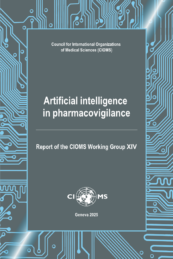
CIOMS WORKING GROUPS
The Council for International Organizations of Medical Sciences (CIOMS) is an international, non-governmental, non-profit organization established jointly by WHO and UNESCO in 1949. CIOMS represents a substantial proportion of the biomedical scientific community through its member organizations, which include many of the biomedical disciplines, national academies of sciences and medical research councils. CIOMS mission is to advance public health through guidance on health research including ethics, medical product development and safety.
The current and recent Working Groups
- Working Group XVII – Long-term safety of medicinal products
- Working Group XVI – Development Safety Update Report
- Working Group XV – Pharmacoepidemiology for Public Health
- Working Group XIV – Artificial Intelligence in Pharmacovigilance
- Good Governance Practice for Research Institutions
- Recommended Standards of Education and Training for Health Professionals Participating in Medicines Development
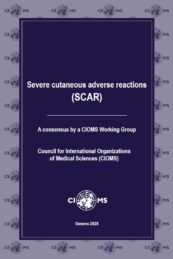
- Severe Cutaneous Adverse Reactions – SCAR
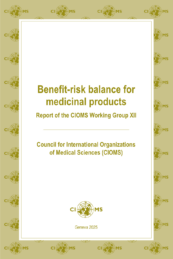
Working Group on Benefit-risk Balance in Medicinal Products
WG Education Standards
WGXIV Artificial Intelligence
CIOMS MEETINGS
Upcoming Meetings
23 April 2026
Virtual
5th Meeting Working Group XVI on Development Safety Update Report
01 June 2026
Virtual
3rd Meeting Working Group XVII on Long-term safety for medicinal products
29 - 30 June 2026
Geneva, Switzerland
4th Meeting Working Group XVII on Long-term safety for medicinal products
28 - 29 September 2026
Geneva, Switzerland
6th Meeting Working Group XVI on Development Safety Update Report
Recent Meetings
Member Organizations